.webp)
Choosing turf in North Texas is not as simple as picking the grass that looks best on installation day. Sun exposure, tree cover, summer heat, foot traffic, irrigation, mowing habits, and winter cold all affect long-term performance.
When comparing Bermuda grass vs St Augustine grass, Bermuda is usually the stronger choice for sunny, high-traffic areas and homeowners who want dense, fine-textured turf. St. Augustine is often better for yards with partial shade and homeowners who prefer a broader-bladed lawn.
Both can work in North Texas, but they solve different problems. The best choice matches the conditions already present on your property.
The difference between Bermuda and St Augustine grass is easiest to see in everyday performance.
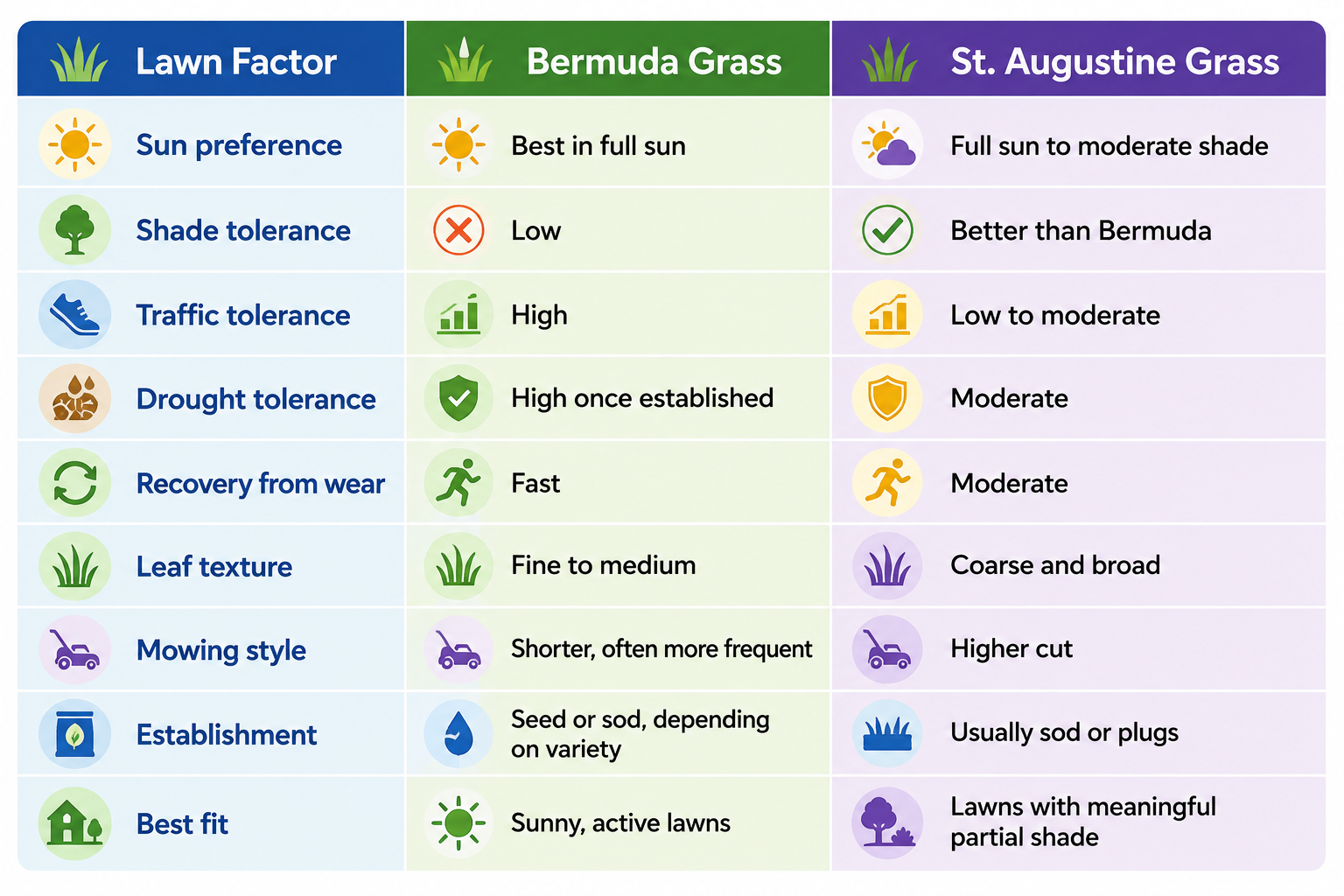
The biggest practical difference is how each grass responds to sunlight and use.
Bermuda thrives with abundant direct sun. It spreads aggressively, builds dense turf, tolerates regular activity, and can recover quickly from wear during active growth.
St. Augustine has wider blades and better shade tolerance. It can remain attractive where Bermuda starts thinning because trees or structures reduce direct sunlight.
A sunny backyard used by children, pets, or frequent guests often favors Bermuda. Its spreading growth habit helps fill small worn areas when growing conditions are good.
Its toughness does not make it maintenance-free. Bermuda can grow quickly in warm weather, so mowing must keep pace. It also performs poorly in substantial shade, even when extra water is applied.
St. Augustine is one of the more shade-tolerant warm-season turf choices used in Texas. That makes it useful on properties with mature trees, filtered sunlight, or sections shaded by the home.
Shade tolerance still has limits. A deeply shaded area receiving very little usable light may fail to support healthy turf of either type.
If you are asking which grass is better Bermuda or St Augustine, start with the lawn's most difficult condition.
Choose Bermuda when the property receives strong sun and needs durability. Consider St. Augustine when partial shade is the main challenge and traffic is moderate.
Bermuda is often a strong fit when the lawn has plenty of direct sunlight, regular foot traffic, active pets, or a preference for a tighter appearance.
It also suits homeowners who are comfortable with frequent mowing during peak growing season and want turf that can recover rapidly from minor wear.
St. Augustine becomes more appealing when trees or buildings create partial shade across significant sections of the property.
There is no single best grass for North Texas because properties can differ dramatically within the same neighborhood.
A newer home with few mature trees may provide ideal sun for Bermuda. A nearby established property with large oaks could have enough filtered shade to make St. Augustine more practical.
Bermuda is often one of the best grass choices for Texas lawns that receive full sun. It handles high temperatures, traffic, and temporary dry conditions well.
St. Augustine generally has the advantage when shade becomes significant. It can maintain coverage with less direct light than Bermuda, although it still needs adequate light to grow.
If an area remains heavily shaded most of the day, mulch, planting beds, or another landscape solution may perform better than forcing turf into unsuitable conditions. Texterra Lawn & Landscaping offers landscape design and installation for properties where lawn and planting areas need to be reconsidered.
North Texas summers challenge both turf types. Water availability, mowing height, soil conditions, reflected heat, and traffic all influence summer stress.
Bermuda handles heat and temporary dry periods very well. An established lawn can slow growth or lose color during drought and recover when moisture returns.
St. Augustine also performs well in warm weather, but it generally has less drought tolerance than Bermuda. Irrigation becomes especially important in sunny areas during extended dry periods.
Overwatering should also be avoided. Constantly wet soil can contribute to weak turf and conditions that favor lawn problems.
If you are deciding between Bermuda or St Augustine grass, observe sunlight across the property before choosing.
Bermuda often becomes thinner as sunlight decreases. Thin turf creates open areas where weeds or bare soil can appear.
Mowing higher may provide limited help in marginal conditions, but it cannot turn deep shade into a suitable Bermuda site.
St. Augustine is more shade tolerant, but it still needs meaningful light. Dense tree canopy combined with root competition can make turf difficult to maintain.
In those areas, converting struggling turf into a landscape bed can sometimes create a cleaner, more sustainable result.
Traffic is another important point in the st augustine grass vs bermuda grass comparison.
Bermuda is commonly used in high-traffic turf because it spreads aggressively. During warm active growth, it can recover quickly from small worn areas.
St. Augustine can form thick turf, but repeated heavy traffic can damage it more easily. Paths created by pets, children, or frequent walking may gradually thin.
If shade favors St. Augustine but one route receives constant traffic, a defined walkway can reduce pressure on the grass.
Good lawn maintenance in North Texas requires different mowing habits for each species.
Bermuda is normally maintained shorter than St. Augustine and may need more frequent mowing during vigorous growth.
Many residential Bermuda lawns are maintained around 1 to 2 inches, depending on variety, equipment, and surface conditions. Consistency matters because waiting too long and then cutting low can expose brown stems.
Weekly mowing is common during active growth, although lower-maintained Bermuda may need more frequent cuts.
St. Augustine is generally maintained higher. The taller cut leaves more leaf area and supports its broad-bladed growth habit.
For either grass, avoid removing more than about one-third of the leaf blade in a single mowing.
Texterra's recurring lawn and grounds maintenance includes mowing, trimming, edging, cleanup, and seasonal mowing-height adjustments based on turf type.
Homeowners searching for the best St Augustine grass for North Texas should consider winter performance as well as shade tolerance.
Raleigh is a commonly used St. Augustine cultivar in Texas and is valued in areas where cold tolerance matters. Other cultivars can differ in color, texture, shade response, drought response, and disease susceptibility.
They can grow beside and into one another, but a mixed lawn is harder to keep uniform.
Bermuda can spread into sunny St. Augustine sections. St. Augustine may hold better in shaded spots where Bermuda loses density.
The grasses have different textures and preferred mowing heights. A setting that suits Bermuda may be too low for St. Augustine.
If a uniform appearance is important, using one primary turf type in each suitable area usually creates a cleaner result.
Lawn care maintenance services in Grapevine should account for the individual property, not only the city.
Grapevine, Southlake, Colleyville, Westlake, Keller, Trophy Club, and Flower Mound include both open properties with strong sunlight and mature neighborhoods with substantial tree cover.
A sunny Grapevine lawn may favor Bermuda, while a nearby property beneath large trees may perform better with St. Augustine or with a combination of turf and landscaped beds.
Texterra Lawn & Landscaping serves these communities with recurring maintenance focused on consistent mowing, edging, trimming, and cleanup. Homeowners can view Texterra's lawn and landscape work to see the polished appearance regular maintenance is designed to support.
Before investing in sod or renovating a lawn, evaluate sunlight, traffic, irrigation coverage, drainage, soil conditions, maintenance expectations, and the appearance you want.
Do not choose St. Augustine only because one corner has afternoon shade. Likewise, do not choose Bermuda simply because it is common next door. Evaluate the areas where turf has to perform every day.
For most full-sun North Texas properties, Bermuda is an excellent option because of its heat tolerance, drought tolerance, traffic performance, and recovery ability. When moderate shade is the defining challenge, St. Augustine is often the better warm-season lawn grass.
Neither eliminates the need for consistent care.
Texterra Lawn & Landscaping provides recurring North Texas lawn care with mowing heights adjusted for turf type and season, detailed trimming, hard edging, cleanup, and visual turf checks. Learn more about Texterra Lawn & Landscaping and review Texterra's Google Business Profile and customer reviews when comparing local lawn care companies.
If you want a cleaner property without managing the weekly mowing schedule yourself, contact Texterra Lawn & Landscaping for a lawn maintenance estimate.
Bermuda is generally better for sunny, high-traffic areas. St. Augustine is often better when partial shade is the primary concern. The right choice depends on the property rather than the region alone.
Both are warm-season grasses, but Bermuda is especially strong in heat and generally has greater drought tolerance. St. Augustine can also perform well in summer when irrigation and mowing are properly managed.
Bermuda is often better for active dogs because it tolerates traffic and recovers from wear faster. No turf is immune to concentrated pet traffic, digging, or repeated damage in the same spot.
St. Augustine generally handles partial shade better than Bermuda. Very dense shade can still be unsuitable, especially where tree roots also compete for water and nutrients.
Bermuda generally has better drought tolerance. Actual irrigation needs depend on soil, rooting depth, shade, temperature, rainfall, and the level of green appearance you expect during dry weather.
It is not ideal. Bermuda is generally maintained lower, while St. Augustine performs better at a taller mowing height. Mixed lawns can therefore be difficult to maintain uniformly.
Bermuda is one of the strongest options for full-sun Texas lawns because it handles heat, wear, and dry conditions well. Site-specific factors should still be considered before installation.
Texterra Lawn & Landscaping provides recurring lawn and grounds maintenance in Grapevine and nearby North Texas communities, including Southlake, Colleyville, Westlake, Keller, Trophy Club, and Flower Mound.